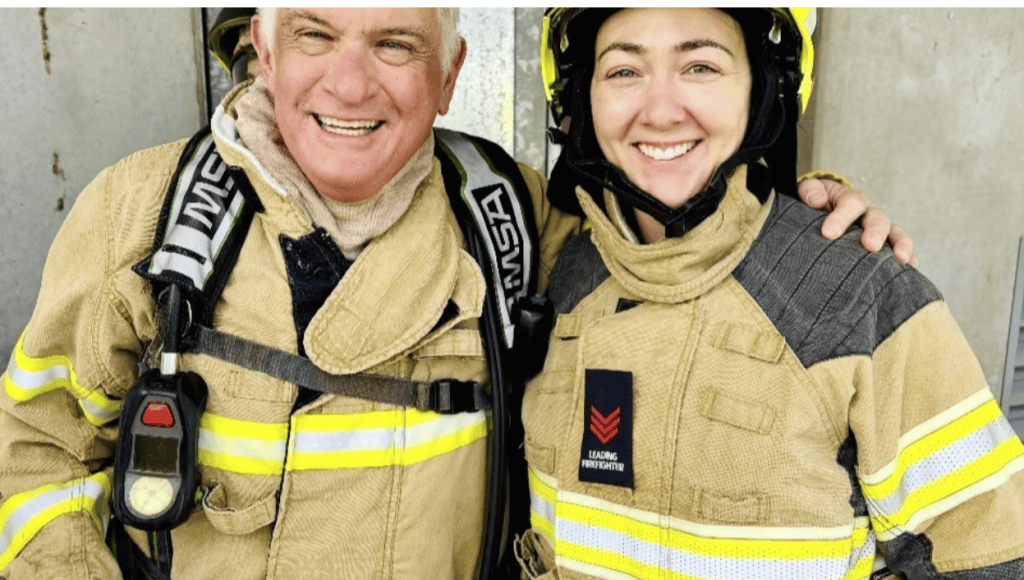
Dr Michael Carr-Gregg AO, MAPS, took part in Fire Ops 101 at the Fire Rescue Victoria Training Academy in Craigieburn. This account has been adapted from his original article with his kind permission.
There is a particular moment in life when you realise you have made a series of decisions that cannot be undone.
For Dr Michael Carr-Gregg, that moment arrived at approximately 10.40am on a cold morning at the Fire Rescue Victoria Training Academy in Craigieburn.
Wearing roughly twenty kilos of turnout gear, with a breathing apparatus set strapped to his back, Michael found himself standing in front of a building that was properly on fire.
Actual flames.
Then came the words from the firefighter beside him:
“Right, Michael. In you go.”
Michael had arrived at Fire Ops 101 expecting a challenging and unusual experience. What he left with was something considerably more meaningful — a first-hand understanding of the physical demands, teamwork, training and responsibility involved in being a firefighter.
What He Learned
Fire Ops 101 places participants into realistic emergency scenarios alongside experienced firefighters, providing a rare opportunity to experience the demands of the job first-hand.
For Michael, one of the biggest surprises was simply how physically demanding firefighting is.
He has spent decades telling young people that exercise is good for their mental health. After a day in turnout gear, dragging charged hose lines and working in heat, he gained a rather different appreciation of what physical exertion really means.
“Dragging a charged hose line is not a workout. It is a negotiation with physics that physics wins.”
Breathing apparatus provided another powerful lesson.
Within seconds of putting on a BA set, the world contracts to the sound of your own breathing and the awareness of your remaining air supply. For Michael, it was a striking demonstration of what happens to cognitive capacity under pressure.
“You become extremely stupid, extremely quickly.”
And that, he recognised, is precisely why firefighters train so relentlessly — so that when the thinking brain is under enormous pressure, training and experience take over.
Heat and fire also behaved in ways that challenged his instincts. Inside the live-fire compartment, every human instinct tells you to get out. Yet the firefighters around him were calmly reading fire behaviour, assessing conditions and working methodically.
Nobody Does Anything Alone
Perhaps one of Michael’s strongest observations from the day was the importance of teamwork.
Not a single task was completed by an individual. Every scenario involved a crew working together as one, with communication that was concise, precise and highly practised.
For someone who speaks professionally about connection and belonging, watching genuine team cohesion under pressure was worth the entire day on its own.
It was a powerful reminder that firefighting is not an individual endeavour. It is about people relying on one another, trusting their training and knowing that every member of the crew has a role to play.
What He Took Away
Michael arrived expecting a novelty experience.
He left with something considerably more sobering.
Firefighters spend their working lives entering environments that every human instinct tells them to flee. They attend fires, road crashes, medical emergencies and other situations that most people never have to experience — and they do so while carrying responsibility for the safety of others.
The experience also changed the way Michael understood conversations about resources, training, equipment and response times.
Those things can sound abstract when discussed in reports, budgets and statistics.
But standing in turnout gear, inside the heat and pressure of a simulated emergency, they become very real.
A response time is no longer simply a number on a spreadsheet.
It represents time — time for firefighters to arrive, assess the situation and begin doing what they have been trained to do.
Michael also came away with a deeper appreciation of the personal impact of the work. Firefighters are exposed to experiences and images that most of us are protected from, and those experiences can accumulate over a career.
A Lasting Impression
Michael expressed his sincere thanks to everyone who made the experience possible, including 3AW’s David Mann, who invited him to take part; Kat Dunell, Acting Station Officer and Fire Ops 101 Coordinator; Ed Starinskas, RTO Chief Executive, Fire Rescue Victoria; and his firefighter buddy, Leading Fire Fighter Megan Kelly.
He also thanked the crews at the FRV Training Academy for their patience, expertise and, as he put it, their admirable restraint in not laughing audibly.
But perhaps his most powerful reflection from the day was this:
“I now understand, in my legs, my lungs and my slightly singed sense of self-importance, exactly what we are asking of the people who run towards the thing everybody else is running away from.”
For Michael, Fire Ops 101 was more than a day of simulated firefighting.
It was an opportunity to experience, however briefly, the physical and psychological demands placed on firefighters and to gain a deeper appreciation of the people who train, prepare and respond when others need help most.
“You are my heroes. Thank you for your service.”
And, with typical Michael Carr-Gregg humour:
Ten out of ten. Would sweat profusely again.
Read Dr Michael Carr-Gregg AO, MAPS’s original article on LinkedIn:
Read the original article on LinkedIn