Keep IBAC accountable
IBAC – The real story
Two investigations. Eight years. No finding of corrupt conduct.
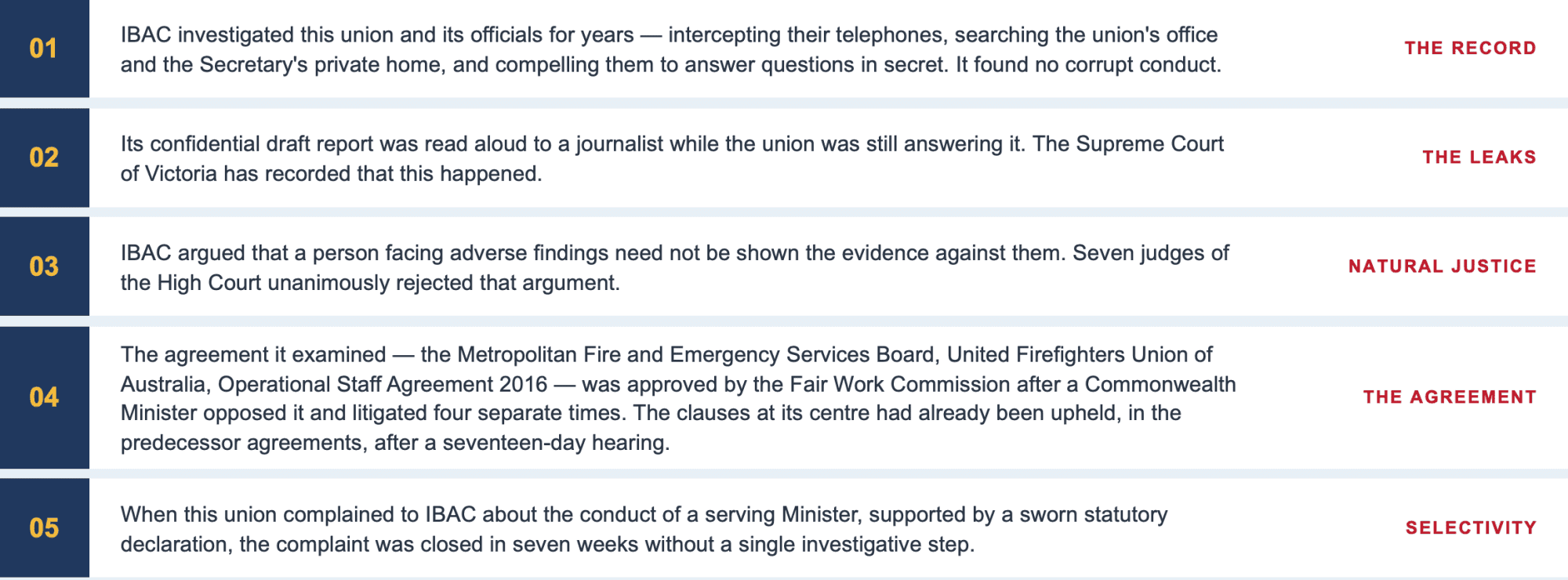
Victoria’s anti-corruption commission spent years investigating this union and its officials. It intercepted their telephones. It executed search warrants. It compelled them to answer questions in secret, on pain of imprisonment. It found no corrupt conduct.
- The Record
Eight years and more than eight million dollars of public money spent, and not one finding of corrupt conduct. The union says plainly what that was: a pursuit in search of a case that never existed.
- The Case In Five Lines
A must read
- The Short Version
An investigation that found nothing, reported anyway
Operation Richmond examined the negotiation of an enterprise agreement between the union and the Victorian Government, and the reforms that created Fire Rescue Victoria.
Bargaining for a public sector enterprise agreement is not corruption. It is the ordinary, lawful business of a registered industrial organisation. Firefighters are entitled to be represented, and their union is entitled to press its claims — including claims about crewing, breathing apparatus, rescue procedures and protective clothing, which are matters of life and death for the people who go into burning buildings.
What is proposed instead
After years of coercive investigation, IBAC has made no finding of corrupt conduct against the union or any of its officials.
What it proposes for publication instead is commentary — framed by concepts such as improper influence and policy capture that appear nowhere in the definition of corrupt conduct in the IBAC Act 2011 (Vic).
And the relationship was never hidden
The Victorian Branch of the United Firefighters Union is an affiliated union of the Australian Labor Party (Victorian Branch), as are most unions in this State. The union resolved to join the Labor Party at its foundation on 22 January 1911, and the affiliation has stood ever since. An affiliated union putting its case to a government formed by that party is not concealed influence. It is a relationship declared on the public record, operating exactly as everybody has always understood it to operate.
The union’s position was set out in its response to IBAC and its further response, with a schedule of 46 corrections.
- CASE STUDY — “CONSULT AND AGREE”
Upheld by the Fair Work Commission, the body with jurisdiction to decide it
The tribunal Parliament established to rule on enterprise agreements refused an employer’s application to terminate the agreements containing them — because firefighters would otherwise lose the right to require agreement, and to press an unresolved safety dispute to a decision.
The clauses at the centre of all this are not perks. They require the employer to consult firefighters, and reach agreement with them, before changing the way they are sent into danger — crewing, breathing apparatus procedures, rescue procedures, the clothing worn into a fire.
In 2014 the MFB applied to the Fair Work Commission to terminate the two agreements containing them. Commissioner Wilson refused the application and dismissed it.
An employer put these clauses to the test, in the forum established to decide exactly that question. It lost. A union that continues to defend them afterwards is not capturing public policy. It is holding a position already adjudicated in its favour.
The hearing
17 days · 37 witnesses · 51 further firefighter statements · 28+ workplace disputes reviewed, four in detail
What the Commission held
Termination would have a “significantly greater negative effect on the employees and the union” than any positive effect on the employer — because disputes genuinely connected with occupational health and safety would no longer require consultation and agreement, nor be able to go through the dispute resolution procedure.
Metropolitan Fire and Emergency Services Board v United Firefighters’ Union of Australia [2014] FWC 7776, [303], [310], [313]–[314] (Commissioner Wilson, 3 November 2014). The quoted words are from the Commission’s own published Summary of Decision, 3 November 2014, AG2014/5121.
- JURISDICTION
The Fair Work Commission is the industrial tribunal. IBAC is not.
Parliament created a tribunal to decide whether the terms of an enterprise agreement should stand, and what may lawfully be put in one. It gave that role to the Fair Work Commission. It did not give it to IBAC.
FAIR WORK COMMISSION
JURISDICTION
Established by the Commonwealth Parliament to approve, vary and terminate enterprise agreements, and to decide which terms may lawfully be included.
PROCESS
Evidence on oath, cross-examination, both parties heard.
REASONS AND REVIEW
Published reasons, appellable to a Full Bench and to the courts.
IBAC
JURISDICTION
Established by the Victorian Parliament to investigate corrupt conduct. No jurisdiction over the terms of an enterprise agreement.
PROCESS
Private examination. No cross-examination by the person affected.
REASONS AND REVIEW
A report that cannot be appealed and cannot be sued over.
No industrial jurisdiction. No industrial expertise. No process capable of testing a contested question of fact. IBAC’s opinion on an industrial clause is entitled to no weight.
- THE AGREEMENT — IT WAS NEVER ABOUT ONE CLAUSE
How the agreement was actually made
Metropolitan Fire and Emergency Services Board, United Firefighters Union of Australia, Operational Staff Agreement 2016
An enterprise agreement has no legal effect until the Fair Work Commission approves it. This approval was contested at every stage, by a Commonwealth Minister and by a statutory equal opportunity commissioner.
3 Apr 2018
MFESB applies to the Fair Work Commission under s 185 for approval of the Agreement (AG2018/1278).
11 Apr 2018
Commonwealth Minister applies to refer the question to a Full Bench. Refused — [2018] FWC 2441 (Hatcher VP).
Metropolitan Fire and Emergency Services Board [2018] FWC 2441 (Hatcher VP).
2018
Minister and the Victorian Equal Opportunity and Human Rights Commissioner intervene, opposing approval.
15 Jan 2019
Gostencnik DP decides discrimination, objectionable terms, s 55, permitted matters and the BOOT — [2019] FWC 106.
18 Feb 2019
Undertakings accepted. The agreement is approved — [2019] FWCA 1023.
26 Feb 2019
The Minister’s application to stay the approval is dismissed.
27 Mar 2019
The Minister’s application to refer a question of law to the Federal Court is dismissed.
22 Oct 2019
A Full Bench determines the Minister’s challenge. The approval is not disturbed — Porter v MFESB; UFU [2019] FWCFB 6255.
Metropolitan Fire and Emergency Services Board, United Firefighters Union of Australia, Operational Staff Agreement 2016
- THE ANSWER TO THE ALLEGATION
Who sits across the table is not the union’s choice
Nothing in the Fair Work Act requires any particular Minister, or any particular official, to take part in bargaining. An employer decides who represents it. A government decides who represents the government.
A union bargains with whoever is put across the table from it. It has no power to choose that person, no power to exclude that person, and no say in who a government sends. To suggest that an agreement is tainted because of who did or did not attend is to make the union answerable for a decision that was never its own.
Read the approval decisions
[2019] FWC 106 — Deputy President Gostencnik, 15 January 2019, on discriminatory terms, objectionable terms, permitted matters and the better off overall test.
[2019] FWCA 1023 — Deputy President Gostencnik, 18 February 2019, accepting undertakings and approving the agreement. Both published in full by the Fair Work Commission.
- A SEPARATE POINT, AND IT MUST BE KEPT SEPARATE
Two kinds of evidence
IBAC has been prepared to comment on workplace conduct, and on occupational health and safety, in the organisations it investigates. Set the material it relies on beside the material that exists about its own workplace.
Adverse comment about an individual
- Statements made in private examinations
- Made by persons not identified to the person affected
- Not tested by cross-examination
- Motive, interest and reliability never examined
- No finding of corrupt conduct made against that person
- Published in a report that cannot be appealed
IBAC's own workplace record
- Measured by the Victorian Public Sector Commission
- Answered by IBAC's own staff, not by this union
- Collected on the same terms as every other agency
- Published, and comparable year on year
- Reported to Parliament by the Integrity and Oversight Committee
- Bullying up on 2019; most named their own manager
- INSIDE IBAC
What do IBAC's own staff think?
IBAC exists to expose misconduct in the Victorian public sector. Its own staff, answering the same public sector survey as every other agency, report bullying at a higher rate than when Parliament’s oversight committee first raised the issue in 2019 — and most of them name their own managers.
16%
of IBAC staff reported experiencing workplace bullying in 2024 — up from 14 per cent in 2019.
59%
of those staff named their own manager or supervisor as the person responsible. A further 29 per cent named someone in senior or executive leadership.
67%
of staff reporting violence or aggression said it came from inside the agency.
IOC, Performance of the Victorian Integrity Agencies 2022/23 (tabled May 2025), drawing on VPSC People Matter Survey results 2019–2024.
What staff say they intend to do next
Turnover measures who has already gone. The survey measures something different: what the people still there intend to do.
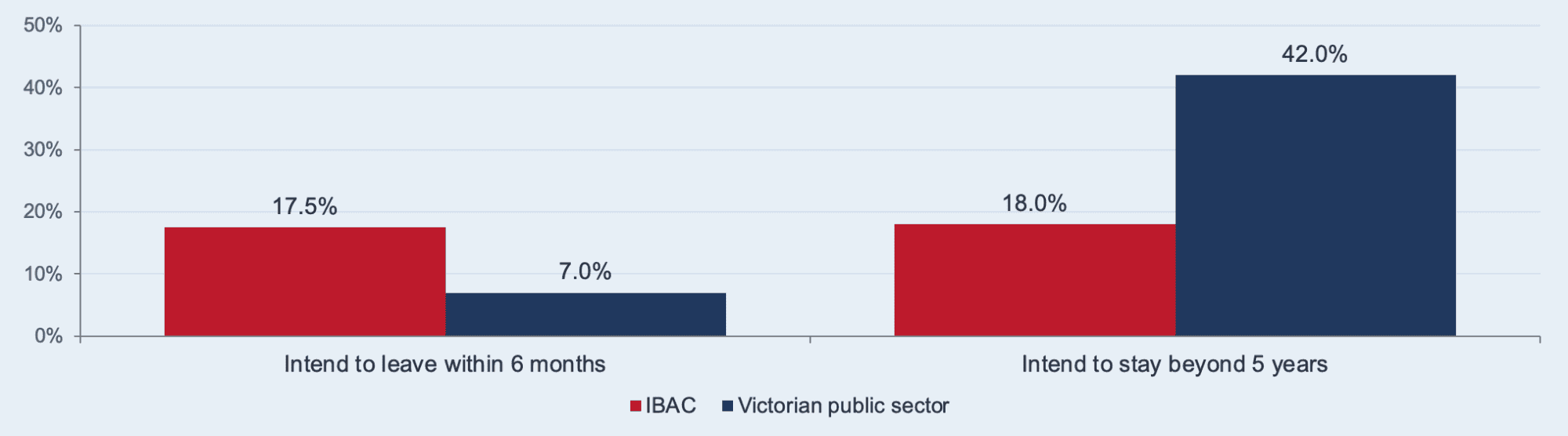
VPSC People Matter Survey, as reported by the Integrity and Oversight Committee.
- PERFORMANCE
IBAC's own performance targets: failure on all fronts
These are not the union’s benchmarks. They are IBAC’s own performance targets, published in the Victorian Budget Papers and assessed by the parliamentary committee charged with monitoring IBAC. In 2022/23 it did not meet a single one of them.
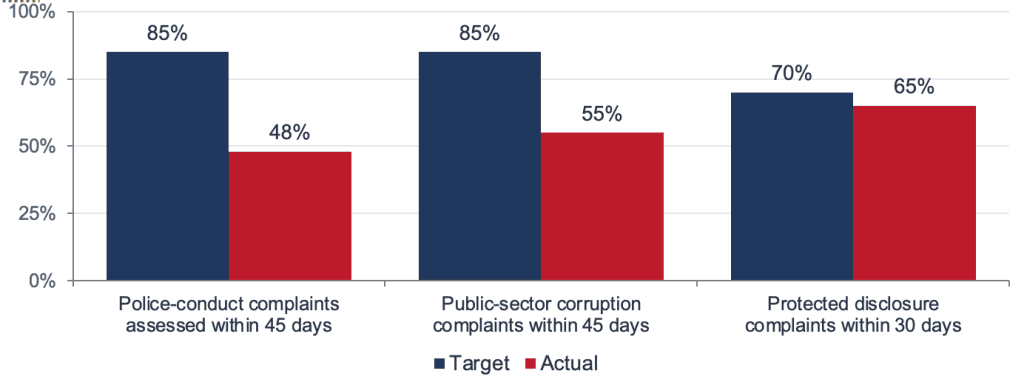
Three targets.
Three failures.
The committee recorded a long-term trend running back to at least 2020/21. In 2023/24 one of four timeliness targets was met.
IOC, Performance of the Victorian Integrity Agencies 2022/23, drawing on Budget Paper No. 3 targets and IBAC annual reports. The committee recorded a long-term trend running back to at least 2020/21.
Then the targets were lowered
IBAC’s annual report for 2024/25 records that it met eight of its eleven Budget Paper targets. That reads as a recovery. Set the two years side by side, on the same measure, and it is something else.
The benchmark was cut by twenty-five percentage points. IBAC then hit it exactly, and recorded the result as met.
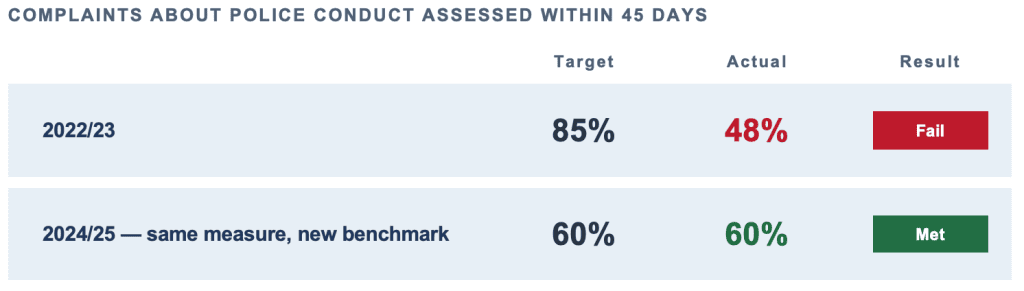
IBAC Annual Report 2024/25, tabled October 2025, Table 3 (performance against Budget Paper No. 3 measures).
Two further results in the same table
59%
of protected disclosure complaints assessed within 30 days, against a target of 70.
25%
of complex investigations completed within 540 days, against a target of 60 — IBAC’s worst result of the year.
And IBAC stopped publishing the figures
The complexity data was withdrawn
IBAC ceased reporting the complexity indicators it had previously published — the number of allegations received and assessed. Without them, year-on-year comparison is difficult and IBAC’s claimed productivity improvements cannot be verified.
The oversight committee says it cannot check
Its conclusion was that IBAC’s public performance reporting no longer adequately explains its continued failure to meet these targets. The one body positioned to check IBAC says it cannot, because IBAC stopped providing the data.
Including how long its reports take
The committee formally recommended that IBAC review the time it takes to complete investigations and report on them publicly.
Operation Richmond commenced in 2018. Its special report was not tabled until 5 August 2026 — more than seven years later
An agency that misses every timeliness target it sets itself, stops publishing the data that would let anyone check, and is told by its own oversight committee that its reporting no longer explains the failure, is not an agency whose untested conclusions should be accepted without scrutiny.
- LEAKS
IBAC’s powers go beyond
IBAC holds some of the most intrusive powers available to any body in the State. It can intercept telephones. It can enter and search. It can compel a person to attend and answer questions in private, and make it a criminal offence for that person to tell anyone — including, in some circumstances, their own family — that it happened.
Those powers are justified on one basis: that the information gathered will be held securely, and that the people caught up in an investigation will be protected until findings are made. That justification depends entirely on the body keeping its secrets.
It did not keep this one.
September 2025
IBAC gave Peter Marshall a draft of its Operation Richmond special report, as the natural justice provisions of its own Act require.
The covering letter warned that unauthorised disclosure of anything in that draft is a criminal offence carrying up to twelve months’ imprisonment.
Within weeks, a journalist was being read passages from it over the telephone.
Marshall v Nationwide News [2026] VSC 427, [11].
What the Supreme Court found
What follows is not the union’s account. It is drawn from a published judgment of the Supreme Court of Victoria, delivered on 1 July 2026, which anyone can read in full.
Marshall v Nationwide News [2026] VSC 427, [4]
In September 2025, while Operation Richmond was in its natural justice phase, a confidential source gave a News Corp journalist information about the contents of IBAC’s confidential draft report — including aspects that directly concerned Peter Marshall. The Court recorded this as uncontroversial, and described the step taken by the source as extraordinary and potentially unlawful.
[2026] VSC 427, [12]
The source read directly to the journalist from sections of the draft report, and summarised others. Asked whether this was safe, the source’s answer was recorded in the evidence: a few dozen people had been given the same information, so it would not be possible to work out who had supplied it.
[2026] VSC 427, [7], [206]
The journalist’s evidence was that Operation Richmond ran in secret for six years, and that the Victorian public knew of its existence at all only because confidential sources had told journalists about it. More than a dozen articles were published between 2019 and 2025.
[2026] VSC 427, [208]
The Court recorded that there is a significant public interest in maintaining the protections in Part 7 of the IBAC Act, for the person under investigation and for the Victorian community, and that it would not condone an intentional breach of the confidentiality obligations in s 166.
Marshall v Nationwide News [2026] VSC 427 (Hannon J, 1 July 2026). Not restricted — published on AustLII. Related: IBAC v Nationwide News [2025] VSC 632 (Forbes J), injunction granted 3 October 2025, final orders 23 October 2025.
- LEAKS — THE LIMIT OF WHAT CAN BE SAID
What the Court did not find
The Court did not find that the draft report came from IBAC, and the union does not say that it did.
Peter Marshall applied for an order compelling the newspaper and its journalist to identify the source. That application was refused. The journalist’s statutory privilege under s 126K of the Evidence Act 2008 was not displaced, the Court finding the competing public interests relatively evenly balanced. On the evidence before her, whether the source had breached s 166 was largely speculative — though her Honour accepted that the inference the report came from IBAC was one available and arguably logical inference.
Why it matters who it was not
Part 7 is a secrecy regime backed by criminal penalty. It exists so a person accused of nothing is protected until findings are made.
The regime failed. Whoever handed it over, the protection Parliament wrote did not hold.
- LEAKS
Who went looking
IBAC
Within days of learning that a journalist held information from its draft report, IBAC was in the Supreme Court seeking an injunction. It got one. The publication was stopped.
Peter Marshall
The separate application to find out who had handed the document over was not brought by IBAC. It was brought by Peter Marshall, Secretary of the UFU Victoria. IBAC was not a party to it.
This was not the first time
The union’s own confidential submission to the parliamentary committee that oversees IBAC — setting out its concerns about unauthorised disclosures — was itself disclosed, and appeared on the front page of The Australian. This is a separate event from the October 2025 article in VSC 427, and the two must not be conflated.
Compare what came before
The national crime authority held compulsory powers of the same order. Its investigations did not appear in the newspapers day after day for six years. The difference is not the powers. It is the discipline with which they were held.
- THE POWERS USED
A search warrant at the union’s office. And at the Secretary’s home.
These are not abstract powers described in a statute. They were used, against this union and against the people who work for it, over a period of years.
- Search warrants
Executed at the offices of the United Firefighters Union, and at the private home of its Secretary.
- Seizure
Material taken included both the union’s records and personal property — private papers, family material and personal communications belonging to people who were not the subject of any allegation.
- Telephone interception
Applied over years, capturing not only the calls an investigator was looking for but everything else on the line.
- Compulsory examination
Attendance and answers compelled in private, with threat of imprisonment, with a criminal offence attaching to telling anyone it had happened.
Every one of these powers was used. No finding of corrupt conduct followed.
- INTERCEPTS
What IBAC was listening to
Telephone interception does not capture only the conversation an investigator is looking for. It captures everything on the line. Over years of interception, that means the whole of a person’s life, and the lives of everyone who rang them.
IBAC now asserts the power to republish material of that kind in a public report in which it has found no corrupt conduct.
Family
Conversations with a spouse, a parent, a child — people who were never the subject of any allegation and were never given any opportunity to be heard.
Health
Discussion of medical conditions, diagnoses and treatment, belonging to people who had no reason to think a State agency was listening.
Bereavement and welfare
Calls about funerals, illness, members in crisis — the ordinary work of a union that looks after firefighters.
Legal advice
Communications touching on the union’s legal position and its lawyers, in matters wholly unrelated to any investigation.
Industrial strategy
Bargaining positions and internal deliberation — lawful conduct by a registered organisation, reframed after the fact as something sinister.
Everything else
Years of ordinary, private, unremarkable life, held by the State, and now proposed for publication without a single finding of corruption.
- NATURAL JUSTICE
IBAC refused to show the evidence
Section 162(3) of the IBAC Act is Parliament’s protection for anyone about to be criticised in an IBAC report. Before publishing an adverse comment about a person, IBAC must give that person a reasonable opportunity to respond to the adverse material.
In an investigation conducted between 2019 and 2021, IBAC gave the people it proposed to make adverse findings against a redacted draft report. It refused to give them the evidentiary material the findings rested on. Its position was that s 162(3) required no more: you may see what we intend to say about you, but not what we say it rests on.
It ran that argument in the Supreme Court of Victoria. It ran it in the Court of Appeal. It ran it in the High Court of Australia.
Put precisely: the appellants were not granted substantive relief, and the Court accepted IBAC had complied by undertaking not to transmit the draft. What was rejected, unanimously, was IBAC’s construction of the section. A body that had to be told by seven judges what a fair opportunity to respond requires is not a body whose assurances on that subject should be taken on trust.
AB (a pseudonym) v Independent Broad-based Anti-corruption Commission [2024] HCA 10; (2024) 278 CLR 300.
13 March 2024
7–0
Seven judges of the High Court unanimously rejected it. “Adverse material” means the evidentiary material IBAC relies on, and a reasonable opportunity to respond requires at least the substance of that material be provided. IBAC was ordered to pay the appellants’ costs of the appeal.
- ADVERSE COMMENT ABOUT THE INDIVIDUALS
Allegations that could not be answered
Where a court or tribunal makes a finding about a person’s conduct, a set of protections applies as a matter of course. They are not luxuries. They are the reason findings can be relied upon. Consider which of them were available here.
The person may call evidence in answer
The person’s counsel may cross-examine the person making the allegation
The motive, interest and reliability of the person making the allegation may be tested
Reasons are given, and may be appealed
A conclusion about a person’s conduct which has never been tested is not a finding. It is an assertion that has been written down by a body with the power to publish it.
IBAC's half conversation
A person may be played part of a recorded conversation and asked to account for it. Not the conversation. Part of it. They have not heard it before. They have no transcript, no copy, and no ability to hear what came before or after. And the part selected has been chosen by the body that has already formed a view about what the material shows.
ILLUSTRATION ONLY — NOT DRAWN FROM ANY INVESTIGATION

In a court, none of this arises. The whole of a conversation goes before the tribunal. The other side can require the remainder to be played. Context is available to be argued about, in front of a decision-maker who must give reasons.
A selected fragment is not evidence of what a person meant. It is evidence of what was selected.
- INVESTIGATIONS
Two IBAC operations. No corrupt conduct.
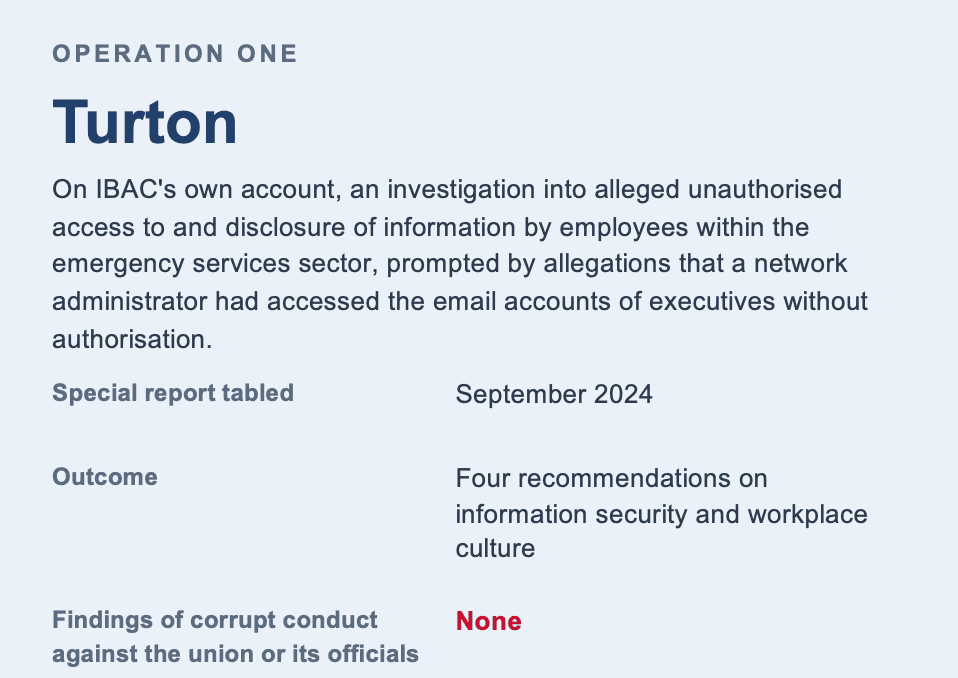
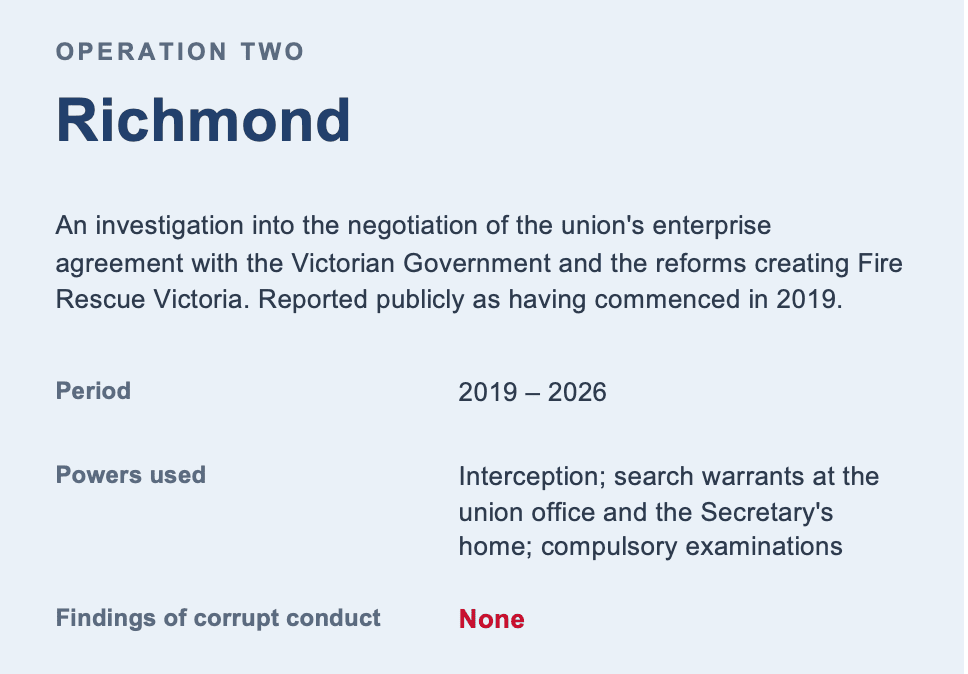
On the union’s estimate, the cumulative cost to the public of both operations exceeds eight million dollars.
- THE UNION'S ANSWER
What IBAC put to us, and what we said
The union responded to IBAC’s draft report in February 2026, filed a further response, and provided a schedule of 46 corrections. Three specimen rows below show the format.
Proposition
That the union exercised improper influence over government decision-making on fire services reform.
The union’s answer
“Improper influence” is not a species of corrupt conduct under the Act. Advocacy by a registered organisation to a government, including forceful advocacy, is lawful and is what members pay their union to do. No finding of corrupt conduct has been made.
Proposition
That the terms sought by the union in bargaining amounted to a capture of public policy.
The union’s answer
The terms in question were health and safety protections, and their retention has been tested and upheld in the Fair Work Commission. A body with no industrial jurisdiction is not the forum in which to re-litigate them.
Proposition
That adverse inferences may be drawn from evidence given in private examinations.
The union’s answer
That evidence was untested, uncross-examined, and in some instances given by people with their own interests in the outcome. The High Court’s decision in AB v IBAC establishes what fairness requires before such material can ground adverse comment.
- THE CASE FOR FIRE SERVICE REFORM
Eight inquiries in under ten years
Any suggestion that the restructure of Victoria’s fire services was a union project which government simply adopted does not survive contact with the government’s own contemporaneous record.
In July 2017 the Victorian Government made a written submission to the Legislative Council Select Committee inquiring into the Fire Services Bill. That submission sets out, at length, why the government said reform was necessary. It rests the case not on the union, and not on any negotiation, but on eight independent inquiries.
2008
Report on the Process to Select New Personal Protective Clothing for Victorian Firefighters
Judge Gordon Lewis AM
2010
Report of the Victorian Bushfires Royal Commission
The Hon. Bernard Teague AO et al
2011
Review of the 2010–11 Flood Warnings and Response
Neil Comrie AO
2014
Hazelwood Mine Fire Inquiry Report
The Hon. Bernard Teague AO et al
2015
Inquiry into the Effect of Arrangements Made by the Country Fire Authority on its Volunteers
Justice David Jones AM
2015
Drawing a line, building stronger services — the Fire Services Review
David O’Byrne
2016
A review of the MFB Employee Support Program
Dr Peter Cotton
2016
Inquiry into the CFA Training College at Fiskville
Parliament of Victoria, Environment, Natural Resources and Regional Development Committee
8
Major inquiries into Victoria’s fire services in under a decade, each identifying the need for change.
309
Recommendations made across those inquiries.
2,276
Submissions considered, from experts, firefighters, representative bodies and the public.
- THE PARLIAMENTARY RECORD
One vote could not have changed it
The Firefighters’ Presumptive Rights Compensation and Fire Services Legislation Amendment (Reform) Bill 2019 was read a third time and passed by the Legislative Council on Thursday 20 June 2019. It did not pass narrowly.
The division as recorded
21–18
Bill passes
One Aye absent
21–18
Bill passes
One Aye votes No instead
20–19
Bill passes
Two Ayes vote No
19–20
Only here does it fail
No single member’s vote determined the outcome. To defeat the Bill, two members of the Legislative Council would have had to change sides. That is not a matter of argument. It is a matter of counting.
Legislative Council of Victoria, Minutes of the Proceedings No. 25, Thursday 20 June 2019, pp 173–174. The Bill also created the presumptive rights compensation scheme for firefighters who contract a listed cancer.
- SELECTIVITY
What IBAC chose to look at
IBAC has a discretion. It cannot investigate everything, and it says so. The question is not whether that discretion exists. It is how it has been exercised.
In 2018 the union and its Secretary made a complaint to IBAC through solicitors, in writing, under Part 3 of the Act. It concerned the conduct of a then serving Minister of the Crown, and alleged conduct the union’s lawyers said may have constituted the offering of a bribe, the dishonest use of influence, or an attempt at both. It was supported by a sworn statutory declaration from a serving firefighter, which identified a further corroborating witness by name.
The union does not say the complaint should have been upheld. It was never tested, and the person it concerned never had the opportunity to answer it. What the union says is narrower, and harder to answer: it should have been looked at.
In the same letter, IBAC determined the complaint was not a protected disclosure complaint — and set out the consequence: that it could provide the Secretary’s identity, and the contents of his complaint, to other agencies.
23 July 2018
Complaint lodged with IBAC, enclosing the statutory declaration.
4 Sept 2018
Further information provided at IBAC’s request.
10 Sept 2018
IBAC declines to investigate and declines to refer, citing its discretion under s 67.
Seven weeks
from complaint to refusal, without a single investigative step.
- CHANGE
IBAC investigates, but who investigates IBAC?
Victoria needs an effective anti-corruption commission. What it says is that a body holding powers of this magnitude cannot be the only institution in the State that is never required to answer for how it uses them.
PATHWAY A
Abolition
Return these functions to bodies subject to ordinary judicial supervision, on the view that a standing commission with coercive powers and a publication function cannot be made safe.
PATHWAY B
Restructure
Keep IBAC, but separate investigation from publication; require a finding of corrupt conduct before adverse commentary may be published; and give the Victorian Inspectorate real enforcement power rather than the power to write reports IBAC disputes.
PATHWAY C
Parliamentary inquiry
A full inquiry into IBAC’s conduct of these operations: the use of intercepted material, the handling of confidential information, the treatment of witnesses, and the cost. Everything else follows from what such an inquiry finds.
The union’s position is that the third is the necessary first step.
- WHAT MUST CHANGE
Nine changes, and the first is not negotiable
Every one of these follows from something set out on this page. None of them would prevent IBAC from investigating corruption. Each of them would prevent a repetition of what has happened here.
01
No publication of private communications where no corrupt conduct is found
Where IBAC makes no finding of corrupt conduct, it should be prohibited from publishing, quoting, summarising or describing any private communication obtained by interception, surveillance device or compulsory examination.
02
No adverse comment about a named person without a finding
Where IBAC finds no corruption, it should say so and stop. Commentary framed in terms found nowhere in the Act carries the reputational weight of a corruption finding without the burden of proving one.
03
The evidence must be provided, as of course
Where IBAC proposes adverse comment, it should provide the evidentiary material said to justify it — without the person having to ask, and without their having to litigate for it.
04
The whole conversation, not the fragment
Where any part of an intercepted communication is put to a person or relied on in a report, the whole of it should be provided, in a form they can review with their lawyers.
05
A right to test evidence that will be used against you
By cross-examination, or an equivalent mechanism permitting motive, interest and reliability to be examined. Nothing presently requires that what a person says about another be tested before it is acted upon.
06
Accountability when confidential material escapes
Where information from a draft report enters the public domain before tabling, IBAC should report to Parliament on how it occurred, what was investigated, and what action was taken.
07
A remedy for the person whose information is disclosed
A right of action against IBAC without first having to identify who disclosed it, with IBAC bearing the onus of showing it took reasonable steps.
08
Reasons when a complaint is refused
Where IBAC declines to investigate a complaint about a public officer above a defined seniority, it should give reasons capable of review — not a citation of the section under which the discretion was exercised.
09
Time limits, and an oversight body with power
A statutory limit on the duration of an investigation and on the period before tabling. Resumed publication of withdrawn performance data. And an Inspectorate with power to require, not merely to recommend.
And one thing that should wait
In June 2026 the Victorian Government announced that IBAC’s powers will be substantially expanded: powers to follow public money into private contractors, with retrospective application, and a broadening of the definition of corrupt conduct beyond criminal offences — to capture serious disciplinary offences, conduct worthy of termination, and serious breach of public trust.
A second point, which should give every reader pause
The complaint made throughout is that concepts such as improper influence and policy capture appear nowhere in the definition of corrupt conduct, and were applied to this union regardless.
The remedy now proposed is to put them into the Act.
Whatever view is taken of that proposal, it should be debated on its merits by Parliament, in public, and not arrive as an accessory to a report about this union.
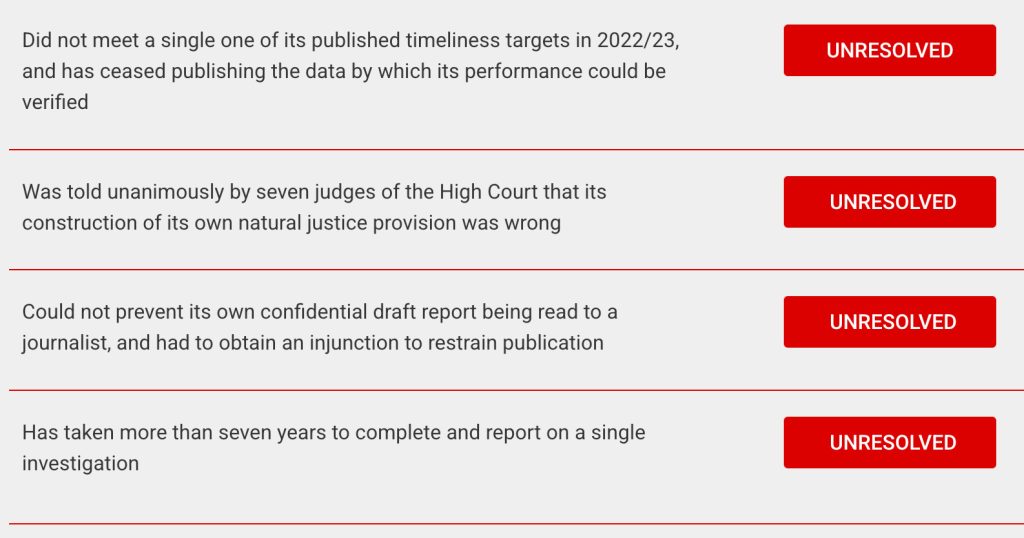
Did not meet a single one of its published timeliness targets in 2022/23, and has ceased publishing the data by which its performance could be verified
Was told unanimously by seven judges of the High Court that its construction of its own natural justice provision was wrong
Could not prevent its own confidential draft report being read to a journalist, and had to obtain an injunction to restrain publication
Has taken more than seven years to complete and report on a single investigation
No expansion of powers before demonstrated compliance with the powers already held.
- WHAT CAN YOU DO
Ask your member of Parliament questions
IBAC answers to Parliament. Parliament answers to you. Members of the Legislative Assembly and Legislative Council can put these questions, and are entitled to an answer.
01
What did Operations Turton and Richmond cost the Victorian public, and what findings of corrupt conduct did they produce?
02
By what authority may IBAC publish lawfully intercepted private communications, and seized personal and medical material, in a report making no finding of corrupt conduct?
03
What has been done about the repeated appearance in the media of information IBAC was required to keep confidential — including a confidential submission to Parliament’s own oversight committee?